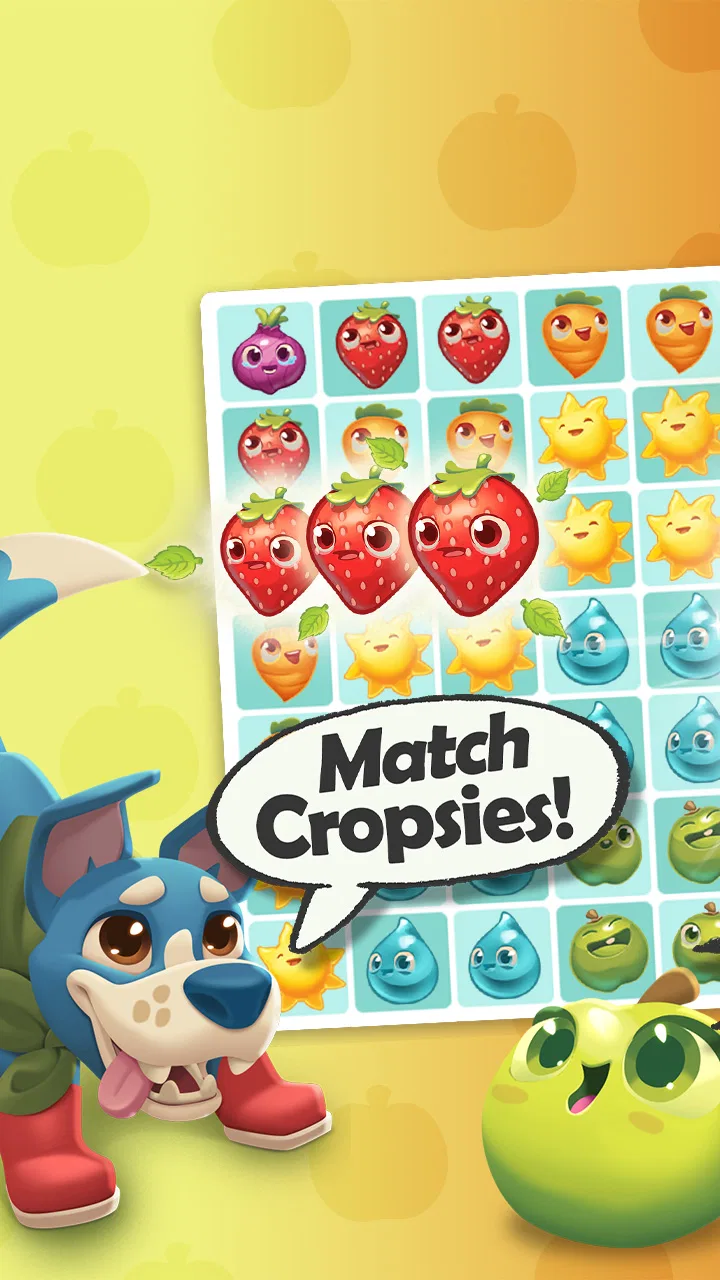
Farm Heroes Saga
- 4.6
- Rating
- 100.00M
- Installs
- Free
- Price

 Analysis by App-foxy
Farm Heroes Saga is the kind of casual game I can pick up for a few minutes without needing to remember a complicated story or learn a large set of controls. Its basic appeal is immediate: I match crops, clear objectives, and move through colorful farm-themed puzzles. That simplicity explains why King’s game has remained so visible among mobile puzzle titles, but the more important question is whether it still deserves a place on your phone after the first burst of novelty disappears.
My answer is generally yes, with an important qualification. I think it works best as a short-session game for people who enjoy planning small moves, accepting occasional setbacks, and returning to a familiar progression loop. It is less convincing for anyone who wants a completely relaxed experience with no pressure, no repeated structure, and no temptation to spend. The game is free to start, rated for Everyone, and available on Android devices running version 6.0 or later, so it is easy to approach. Keeping it enjoyable over time depends more on how you play than on whether you like the first few levels.
Why the first week feels so inviting
The opening experience is built around quick understanding. I do not have to study a long tutorial or memorize a collection of unusual gestures. The board presents a familiar matching idea, while the farm setting gives the activity a warmer identity than a plain grid of colored pieces. Crops become the visual language of the puzzle, and each successful move feels connected to the immediate task rather than buried under menus.
You May Also Like

 Blood Strike: 2.5 Anniversary
Blood Strike’s Loadouts Turn Every Drop Into a Tactical Gamble
A close look at Blood Strike’s custom loadouts: how fast access to signature weapons reshapes its battle royale rhythm, rewards preparation, and narrows the gap between fights.

 Pandora - Music & Podcasts
Pandora’s Music Is Easy to Start, but Harder to Recover
Pandora’s strength is its low-effort path from a seed to a station. Its weak spot is how much confidence it asks you to place in connection, setup, and quiet recovery.

 8 Ball Pool
 Is Built on Rivalries, Rematches, and Routine
A close look at the rivalries, rematches, shared routines, and unanswered safety questions that turn a quick pool match into a persistent mobile community.

 Samsung Music
’s Quiet Strength Is Playing What You Already Own
Its reach comes less from spectacle than from dependable access to a personal library. That simplicity is both the app’s strongest retention engine and its ceiling.

 AccuWeather: Weather Radar
AccuWeather Review: A Quick, Clear Forecast for Everyday Decisions
For everyday plans, the best forecast is the one you can understand quickly. AccuWeather makes rain timing, radar, and local conditions easy to act on, with a few trade-offs.

 Hill Climb Racing
Why Hill Climb Racing Still Turns Crashes Into One More Run
A tiny car, a bumpy hill and one more upgrade: Hill Climb Racing keeps resurfacing because its simple chaos makes every near-miss feel personal.
More From Our News Desk
View All News


That makes the game especially suitable for small gaps in the day. I can play while waiting for an appointment, during a short commute when it is safe to do so, or at the end of an evening when I want something lighter than a strategy game. A level usually asks me to focus on one clear goal, so I am not carrying a large amount of information from one session to the next. This low memory load is one of its strongest practical qualities.
The early levels also teach an important habit: matching more thoughtfully is usually better than making the first available move. I try to look for combinations that affect several nearby crops rather than clearing isolated pieces immediately. That small change in approach makes the game feel less like tapping randomly and more like solving a compact visual problem. It is a useful distinction because the controls are simple, but the better decisions are not always obvious at a glance.
Another reason the first week has momentum is the steady sense of completion. Finishing a level gives me a clean stopping point, and the next challenge is visible without demanding a long commitment. This is a better fit for casual players than games that expect a continuous session. If you only have ten minutes, you can still feel that you accomplished something rather than merely making progress toward a distant objective.
King has kept the presentation cheerful and approachable. I would not describe the visuals as a reason to buy a new device, but they do their job well: crops are easy to distinguish, the board is readable, and the farm theme gives the journey a consistent personality. The sound and animation support the matching feedback without turning every move into an elaborate event. For me, that balance matters because excessive effects can make a simple puzzle feel tiring surprisingly quickly.
The game’s popularity is substantial, with an average rating of 4.6 from roughly 9.9 million ratings and more than 100 million installs. Those figures do not guarantee that every player will enjoy it, but they do reflect how accessible the basic formula is. I would recommend the first-week experience to someone who likes familiar match puzzles and wants a game that can be understood almost immediately.
What to learn before progress becomes harder
The most useful early tip is to pause before every move, even when the board looks generous. I look at the entire play area and identify which crops are closest to the current objective. A move that creates a large cluster may be less valuable than one that removes the specific crop type I need. This is a small discipline, but it reduces the feeling that later failures are arbitrary.
I also avoid treating every level as a race. When the board allows it, I set up a better match instead of taking a merely acceptable one. This is particularly helpful when objectives involve several crop types or limited opportunities. The game remains casual, but it rewards the kind of patience that many players bring to traditional puzzle books.
One realistic use case is a parent looking for a quiet, age-appropriate diversion that can be shared with a child. The Everyone rating makes the audience broad, and the farm theme is less intense than action-oriented alternatives. Still, I would not hand over a device without discussing in-app purchases. The game is free, but individual purchases range from $0.99 to $239.99, so family use deserves sensible spending controls and clear expectations.
Whether the routine holds up from month to month
After the initial week, the central question changes. At first I am learning how the board behaves; later I am asking whether another level feels meaningfully worthwhile. Farm Heroes Saga earns continued attention through its short, self-contained challenges and the satisfaction of improving a plan that did not work the first time. It is not a game I play for a deep narrative or a changing set of genres. Its value comes from repetition with small variations.
That can be enough if matching games are already part of your routine. I like having a dependable option that does not require a large time investment. On a busy day, I may play one level and stop. On a quieter day, I may continue until a difficult board makes me want to take a break. The flexibility is genuine: the game does not need to dominate my attention to remain useful.
For month-to-month value, I find the strongest benefit in its predictable rhythm. There is comfort in knowing what kind of mental activity I am opening. Unlike a competitive multiplayer game, it does not require me to coordinate with other people or maintain a particular skill level to participate. Unlike a large role-playing game, it does not ask me to remember a complicated inventory, map, or story thread. That makes it a good fallback game, especially for players who want a familiar puzzle rather than a second job.
There is a trade-off, though. The same consistency that makes it easy to return can also make it feel repetitive. The farm setting changes the mood, but it does not transform the underlying matching format. If you need constant novelty, you may prefer a puzzle collection that switches between different mechanics. If you enjoy polishing one style of play, this game is more likely to remain comfortable over time.
I would also be careful about confusing progress with lasting engagement. Moving through a level path can create a strong reason to return, but that reason may weaken once the routine becomes automatic. My best experience comes when I treat the game as a small daily option, not as a task that must be completed. Skipping a session is healthier than forcing myself through levels simply to preserve momentum.
How it compares with familiar alternatives
Compared with a traditional match-three game built around gems or candies, this one feels more focused on collecting and cultivating a farm-like set of objectives. That theme gives the board a softer identity, and I find it more inviting when I want something cheerful rather than flashy. The underlying appeal is still recognizable, so players moving from another matching game will not feel lost.
Compared with endless arcade games, it is less dependent on reflexes. I can think through a move instead of reacting to a timer or a constantly moving screen. That makes it a better choice for relaxed play, but a worse choice if you want physical excitement or rapid competition. Compared with word puzzles, it offers less language practice and more visual planning. The right alternative depends on what kind of attention you want to use.
It also differs from more open-ended farming games. I am not managing a detailed farm economy or designing a large personal space; the farm is the setting for structured puzzles. Someone expecting a simulation with building, production, and long-term customization may find the experience too narrow. Someone who wants a matching game with a clear agricultural flavor will probably appreciate that the theme does not get in the way of the board.
The maintenance burden behind the easy start
One advantage is that the game does not demand much maintenance from the player’s memory. I can leave it alone and return later without relearning a control scheme. The current version is 6.83.18, and the stated minimum operating system is Android 6.0, which keeps the technical entry point relatively broad for Android users. On iOS, the same practical consideration applies: it is worth checking device compatibility before committing to a long-term game habit.
Maintenance is more about managing attention than managing the app. Because levels are short and progress is visible, it can be easy to open the game reflexively whenever I have a spare moment. I recommend deciding in advance whether you are playing one level, a short break’s worth, or simply stopping after a failed attempt. That boundary helps preserve the game’s relaxing quality.
Lives, failed attempts, or difficult objectives can create friction depending on the level. I do not see that as a reason to reject the game outright, but it changes how I use it. When a board starts feeling like a demand rather than a diversion, I close the app and return later. Continuing while annoyed tends to produce worse decisions and makes the whole experience feel more restrictive than it needs to be.
Purchases are another part of the maintenance question. The game costs nothing to download, but optional items can become expensive at the upper end of the listed range. I would not recommend playing with unrestricted payment access, especially on a shared family device. A simple personal rule works well: only spend when the purchase genuinely improves your enjoyment, not because a single frustrating level has made you impatient.
That approach also answers a common concern about whether the game can be enjoyed without paying. I think it can, provided you accept that progress may sometimes require patience. Free play is most comfortable for people who are willing to stop, wait, or try a level again rather than immediately remove every obstacle. If your idea of fun depends on instant access to every advantage, the free model may feel more irritating.
Where fatigue begins to appear
The first source of fatigue is repetition. Matching crops remains pleasant for a while, but the core action does not become a completely different game after the novelty fades. I notice this most when I play for too long in one sitting. The cheerful presentation cannot fully disguise the fact that I am making variations on the same type of decision.
The second is the emotional swing between a clean win and a board that seems to resist the plan I had in mind. Puzzle difficulty is part of the appeal, yet repeated failed attempts can turn a five-minute diversion into an extended negotiation with the device. My practical solution is to stop after a couple of frustrating tries, then return with fresh attention. That is not just a relaxation tip; it often leads to better board reading.
A third issue is the temptation created by optional purchases. Even when I intend to play for free, a difficult moment can make a paid shortcut look attractive. This is where the game is not right for everyone. Players who dislike in-app purchase prompts, or who want a completely fixed-cost experience, should consider a paid puzzle with no purchase pressure instead.
There is also a difference between casual and effortless. The rules are accessible, but later decision-making can require concentration. I would not choose this as background entertainment while trying to follow a conversation or watch a complicated program. It is better suited to a single modest focus, even if that focus lasts only a few minutes.
On the other hand, I do not think the game needs to be played daily to justify keeping it installed. Its value is strongest as a reliable option I can revisit when I want a familiar visual puzzle. That makes it less of a habit-building tool and more of a personal shelf item: useful when the mood matches, harmless to ignore when it does not.
My long-term verdict on keeping it installed
Farm Heroes Saga earns lasting space on my phone if I want a friendly, low-barrier matching game that fits around real life. King has made the central interaction easy to understand, while the farm theme gives the progression enough character to stand apart from a completely plain puzzle board. The game is free, suitable for Everyone, and supported by a very large player base, so it is an easy recommendation for families and casual players who know what they are getting.
I would recommend it to someone who enjoys short sessions, likes planning around objectives, and can tolerate repeating a familiar format. It is especially useful as a quiet break between tasks, a simple game for an older Android device that meets the minimum requirement, or a shared casual activity where the rules can be explained quickly. I would suggest setting purchase limits from the beginning rather than waiting until frustration makes a decision for you.
I would skip it if you want a narrative adventure, a deep farming simulation, intense competition, or a puzzle experience with no monetization pressure. I would also avoid making it a compulsory daily routine. The game is at its best when it remains optional and lightweight. Once progress starts feeling like an obligation, its strongest advantage—easy, flexible entertainment—has been lost.
My final view is positive but measured. The first week is the easiest part to enjoy, yet the game can survive beyond that stage because it offers dependable short-form puzzles rather than demanding constant commitment. Its weaknesses are equally clear: repetition, occasional frustration, and the need to manage optional spending. Its lasting value comes from controlled use, not endless use. If that matches the kind of mobile game you want, Farm Heroes Saga is a worthwhile free casual download; if you need constant novelty or a firm one-time price, another puzzle style will serve you better.
With its release on December 10, 2013, it has had plenty of time to establish this identity, and the continued interest reflected in about 436 thousand written reviews suggests that the formula still connects with many players. I would not install it expecting a radically new experience every month. I would install it expecting a polished, approachable farm-themed matching game that remains useful whenever I want a brief mental reset.
FAQs for Farm Heroes Saga
01What is the objective of Farm Heroes Saga?
In Farm Heroes Saga, players aim to match cropsies by swapping them on a grid to achieve certain objectives within a limited number of moves. The game challenges users with various levels, each requiring strategic thinking and planning to collect specific cropsies and overcome obstacles.
02Is Farm Heroes Saga free to play?
Yes, Farm Heroes Saga is free to download and play. However, it does offer in-app purchases for boosters and extra lives, which can enhance gameplay or help you progress more quickly through challenging levels. Players can enjoy the game without making purchases, but these can provide additional convenience.
03How does the energy system work in Farm Heroes Saga?
Farm Heroes Saga employs a life system where players start with a limited number of lives. Each failed level attempt costs a life, and lives regenerate over time. Alternatively, players can purchase additional lives or request them from friends. Managing your lives effectively is key to continuous gameplay.
04Can I sync my progress across multiple devices?
Yes, you can sync your progress in Farm Heroes Saga across multiple devices by connecting the game to your Facebook account. This ensures that you can continue playing from where you left off, regardless of which device you're using, as long as you're logged into the same account.
05What are boosters in Farm Heroes Saga and how do they work?
Boosters in Farm Heroes Saga are special items that help players clear levels more easily. They can perform actions like removing specific cropsies, shuffling the board, or increasing the number of moves. Boosters can be earned through gameplay, as rewards, or purchased through in-app transactions for quicker level advancement.
Pros
- Charming graphics and animations.
- Wide variety of challenging levels.
- Regular updates with new content.
- Engaging and addictive gameplay.
- No internet required for offline play.
Cons
- Frequent ads can be intrusive.
- In-app purchases can get costly.
- Energy system limits playtime.
- Some levels feel repetitive.
- Requires strategic planning to advance.

Farm Heroes Saga
Gallery